There are places in the world where travel stops being tourism and starts being something harder to name. Where the scale, the history, and the sheer visual force of a site demands more than a quick photo and a move on. Batu Caves, just north of Kuala Lumpur in Malaysia, is one of those places.
It’s known primarily as a Hindu pilgrimage site, and that’s accurate. But reducing Batu Caves to a religious destination misses most of what makes it extraordinary. The complex is a living intersection of ancient rock formation, centuries of spiritual tradition, monumental sculpture, vibrant colour, and cultural events that draw hundreds of thousands of people from across the world. For anyone who cares about art, culture, and the way human communities create and celebrate meaning, Batu Caves is essential.
Here are eight reasons it belongs at the top of the list.
1. The Sheer Scale of It Stops You Cold
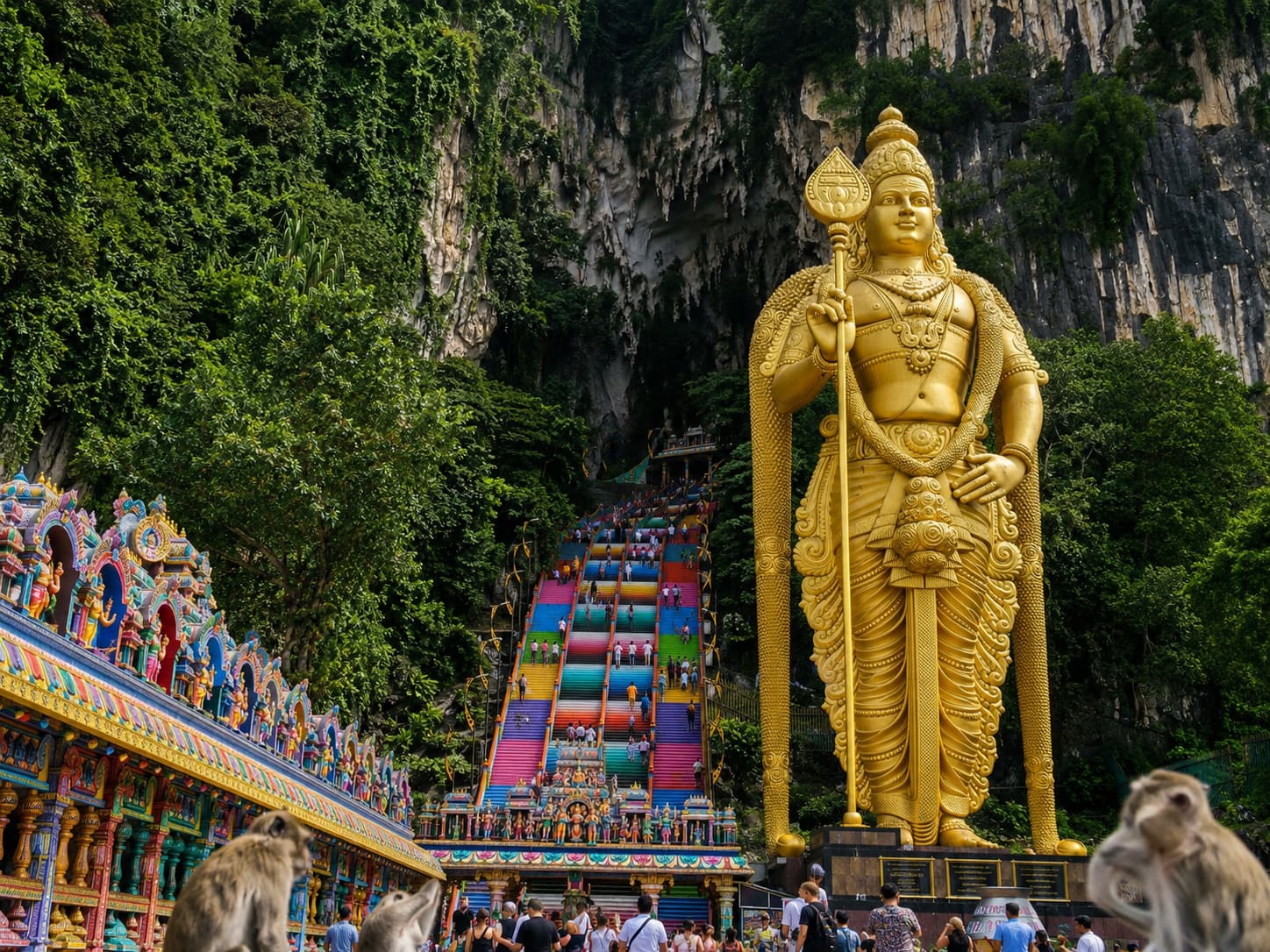
You see the golden statue from the road. At 42.7 metres, the statue of Lord Murugan at the cave entrance is the tallest representation of a Hindu deity in the world. It’s covered in gold paint and catches the light in a way that photographs genuinely cannot prepare you for. Flanking it, at the base of the famous 272-step staircase, are murals, shrines, and vendor stalls in a chaos of colour and noise that feels like arriving at the edge of a different world.
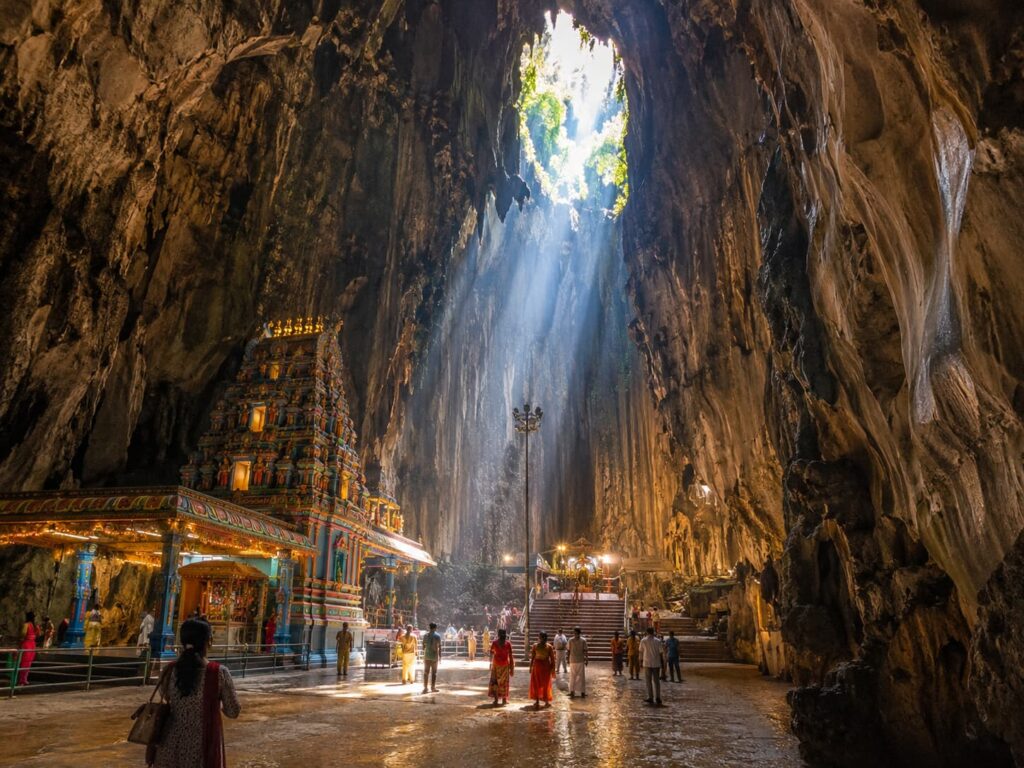
The stairs themselves are painted in vivid stripes of yellow, orange, and red. Each step is steep. By the time you reach the top, slightly breathless, you’re standing at the mouth of the main Cathedral Cave, a limestone cavern roughly 100 metres high with natural skylights that pour afternoon light down onto the shrines inside. The contrast between the riot of colour outside and the quiet, echoing dark of the cave is the kind of experience that stays with you.
2. It’s a Masterwork of Living Religious Art
Batu Caves isn’t a museum. The temples inside and around the cave complex are active places of worship, tended daily, decorated and redecorated across generations. The art here is not static. New murals get painted. Shrines are maintained, refurbished, expanded. Festival decorations transform the entire complex for major events. The result is a form of collective, cumulative artistic expression that has been building for well over a century.
The site was formally established as a Hindu shrine in 1891, when K. Thamboosamy Pillai installed a statue of Lord Murugan in the main cave. In the 130-odd years since, the complex has grown into one of the most visually dense and culturally layered sacred sites in Southeast Asia. For anyone who works in cultural event production or arts programming, seeing what sustained community investment in a shared space produces over generations is genuinely instructive.
3. The Thaipusam Festival Is One of the Most Intense Cultural Events on Earth
Once a year, usually in January or February depending on the Tamil calendar, Batu Caves hosts Thaipusam. Around 1.5 million pilgrims and visitors descend on the site over three days. Devotees carry kavadi, elaborate metal structures decorated with peacock feathers, flowers, and fruit, some of which are attached to the skin via skewers and hooks as a form of devotion and penance. The procession from Kuala Lumpur’s Sri Mahamariamman Temple to Batu Caves covers several kilometres, with drumming, chanting, and music running continuously.
It’s not a performance in the conventional sense. There’s no ticketing, no stage, no formal program. It’s an event produced entirely by a community, for a community, across centuries of tradition. Thaipusam is the kind of cultural happening that reminds you what collective human experience looks like when it’s not mediated by a production company. Anyone involved in cultural event organisation will come away from it with a completely different frame of reference for what a large-scale event can be.
4. The Geology Is As Dramatic As the Culture
The caves themselves predate the shrines by about 400 million years. The Batu Caves limestone massif is one of the oldest geological formations in Malaysia, and the karst landscape it creates, all vertical cliffs, hanging stalactites, and cathedral-like chambers, is the kind of natural architecture that makes anything humans build look modest by comparison.
There are multiple cave systems within the complex. The main Cathedral Cave is the most visited, but the Dark Cave alongside it is a serious natural heritage site, home to cave-adapted species found nowhere else, including rare spiders, fish, and a significant population of Cantor’s roundleaf bats. Guided natural history tours of the Dark Cave run separately from the cultural pilgrimage route and are worth doing for a completely different perspective on the same limestone.
5. Kuala Lumpur Makes the Perfect Base for the Whole Region
Batu Caves sits about 13 kilometres north of central Kuala Lumpur, reachable by train in around 30 minutes. That proximity matters because KL is one of Southeast Asia’s great food and cultural cities, and using it as a base lets you combine a Batu Caves visit with a much wider experience of Malaysian art, food, and daily life.
The city’s Chinatown, its colonial-era architecture, its modern gallery spaces, and its extraordinary street food scene are all within easy reach. Malaysia’s particular cultural mix, Malay, Chinese, Tamil, and a dozen smaller communities, produces a level of visual and culinary variety that rewards slow exploration. Batu Caves is the kind of destination that works best when it’s part of a longer trip rather than a single-day detour.
6. Guided Tours Unlock the Stories Behind What You’re Seeing
The iconography at Batu Caves is extensive and specific. Each statue, each mural, each shrine has a narrative behind it drawn from Hindu scripture, local history, and community tradition. Without context, it’s visually overwhelming but semantically opaque. With a good guide, the entire complex starts to make sense as a coherent body of work.
Operators like Batu Caves Tours offer guided experiences that move through both the cultural and geological layers of the site, explaining the mythology behind the main deities, the history of the Tamil community in Malaysia, and the practical details of how the cave temples function as living religious spaces. For visitors with a background in art or cultural programming, this kind of contextual depth transforms the visit from impressive spectacle to something more genuinely educational.
7. The Art Direction of the Site Is Worth Studying in Its Own Right
The visual language of Batu Caves draws on South Indian Dravidian temple architecture, a tradition distinguished by its use of dense, layered ornamentation, vibrant colour, and figurative sculpture packed with symbolic meaning. The gopuram style towers covered in painted figures that you see at the cave entrance are direct descendants of temple architecture from Tamil Nadu, transported and adapted to a Malaysian hillside.
What’s interesting from a design perspective is how the site has evolved. The original cave shrines are austere by comparison to the explosion of colour and sculpture that surrounds them today. The visual environment has been shaped by successive generations of artists, craftsmen, and community patrons who each added their layer to the composition. It’s a form of collaborative art-making across time that has no equivalent in most Western cultural contexts. For organisations involved in artistic events and the relationship between community and creative expression, the site is a case study worth examining closely.
8. It Changes Depending on When You Go
Batu Caves on a quiet Tuesday morning is a very different experience from Batu Caves on a festival weekend. Both are worth having. The quieter visit gives you space to look carefully, to sit inside the Cathedral Cave and let the silence and the light work on you without the crowd. The festival visit is overwhelming in the best sense: colour, sound, movement, and collective human energy at a scale that few cultural events in the world can match.
Beyond Thaipusam, the site marks several other Hindu festivals across the year, each with its own visual character and community gathering. Navaratri in autumn brings classical dance performances. Deepavali brings illuminations. The cave complex is never quite the same twice. Travelers who visit once often find themselves planning a return at a different point in the calendar year, which is not something you can say about many destinations.
A Final Thought
There’s a category of place that people who work in culture and the arts tend to respond to more strongly than most. Places where you can see, in physical form, what sustained human investment in collective meaning actually produces. Batu Caves is one of them.
The gold statue, the painted stairs, the cave temples, the festival crowds: none of it happened by accident or by the decision of a single person. It accumulated. Generation by generation, decade by decade, a community kept building and decorating and gathering and the place kept growing into something that no single mind could have planned. That’s not a bad model for thinking about culture more broadly.
If you’re planning a trip to Southeast Asia, put Batu Caves on the list. Go with time to spare. And if you can arrange to be there during Thaipusam, do that. Some things need to be seen at full scale to be understood.